
The Differences Between Extruders and Expanders
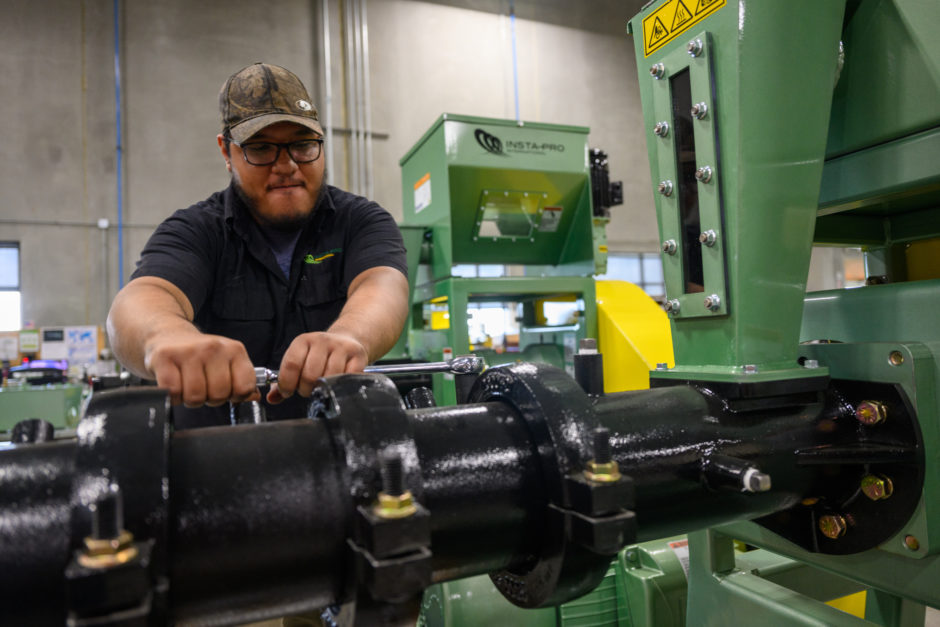
There are several times when we talk with customers who use the terms “extruder” and “expander” interchangeably. Conceptually, it is easy to see why this can happen. Both have barrels that process products by “extruding” them out of the end. It is important to understand the differences between these two processes to maximize the quality of your end product.
A common design is the “interrupted flight” expander. Inside the barrel, there is a very long shaft and auger assembly. Unlike a typical single screw extruder, there are a series of pins that help to create shear along with the screw design. The clearances are increased to allow product to mix into itself, creating shear and cook. A hydraulic cone is used to create backpressure in the barrel, further increasing product cooking temperature.
Expanders typically have lower shear rates than our high-shear dry extruders, leading them to have decreased barrel pressures and temperatures. High temperatures and pressures in the barrel, are key to deactivating antinutritional factors in oilseeds. To achieve higher cooking temperatures, it is common to inject steam into the expander barrel to increase temperatures. A disadvantage with this design is the requirement to dry the end-product, as opposed to simply cooling it prior to storage as is the case with extruders.
A common application for expanders is in the solvent extraction side of the oilseed industry. The ability of expanders to partially rupture cellular structures makes the solvent extraction process more efficient.
In contrast, a high-shear dry extruder will excel in areas such as cook percentage (gelatinization), nutrient availability, and anti-nutritional factor deactivation. This is not to say expanders are not capable of this, but due to the extruder’s increased shaft speeds, tighter clearances, and increased shear, these properties are increased. Inside the extruder barrel, the mixing of product and heat generation from shear causes changes on the cellular level, thus enhancing digestibility and nutrient availability.

The design of the extruder allows for flexibility of restriction dependent upon material properties. A smaller footprint also allows for installation in places that may be too small for a typical expander as well. Insta-Pro’s extruder footprints have been further reduced in the larger capacity 9000 extruder, which requires about 50% less space than 2 x paired 2000 extruders, for the same throughput/capacity. The additional advantages of not requiring a boiler for steam generation and/or dryer heat make a high shear dry extruder a more sensible choice for a variety of applications.

As always, the final selection will be dependent upon many factors. Final product performance should be the most important as this will allow maximum return on investment from an efficiency standpoint. While there are similarities between these two machines, the fine details will allow for the right machine selection. Please reach out to a member of our team to conduct a feasibility analysis to find the best system for your operation.